
Why Exit Interviews Are A Joke
A frank guide to anticipating loss, protecting top performers, and asking the right questions before it's too late

If you are waiting until the exit interview to find out why your best people are leaving, you’re not leading — you’re performing an autopsy.
By the time someone sits down to discuss their “feedback,” they have already mentally moved into their new office. The data is stale, the talent is gone, and the cost of replacement is already a sunk cost.
Plus, what you’re getting in that room isn’t candid intelligence. It’s heavily edited, legally cautious, emotionally detached closure. You’re asking someone who no longer cares about your strategy to improve it. That’s not a listening session. That’s theater.
Exit interviews as a retention tool are a structural absurdity. The very premise — that someone on their way out will give you the honest feedback that might’ve kept them — ignores everything we know about human psychology, workplace loyalty, and the chilling effect of not wanting to burn bridges.
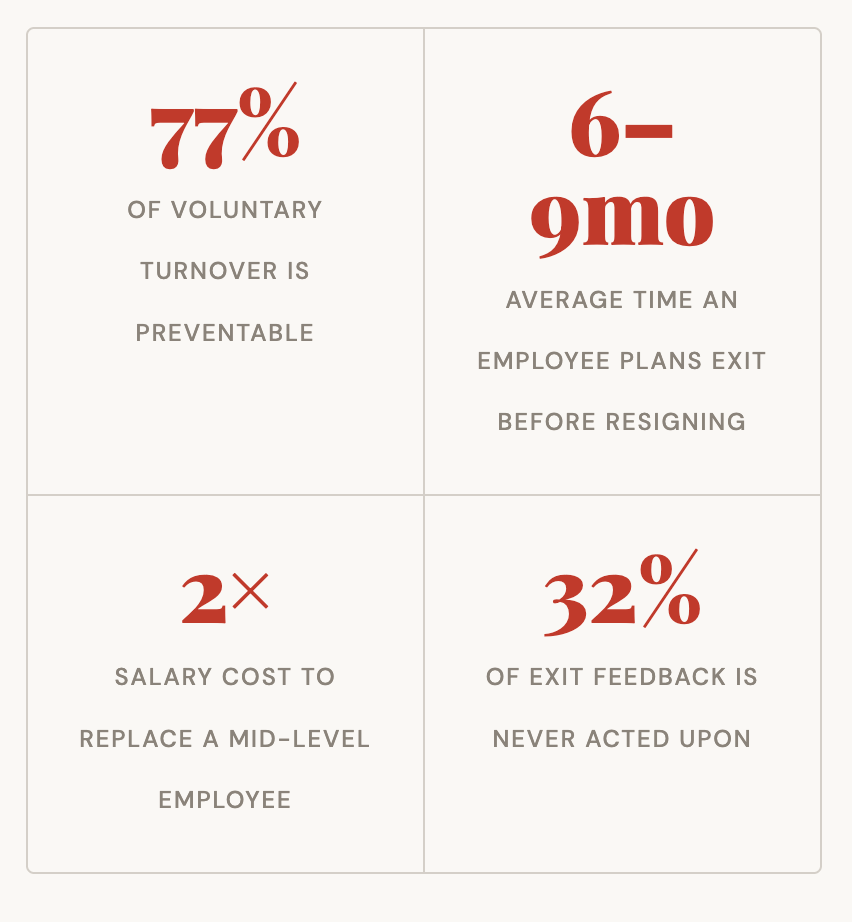
Most people give you the “safe answer.” The real answer lived in their heads for six to eighteen months before they handed in their notice.
Why the Exit Interview Fails
The structural problems are obvious once you name them.
First, there’s no psychological safety. Even the most open-door organization can’t guarantee that what’s said in an exit interview won’t color references, severance, or professional reputation. Employees know this. So they talk about “better opportunities” and “career growth” instead of telling you what’s actually been going on.
Second, the data is retrospective. You’re collecting information about conditions that existed in the past, from someone whose perspective has been filtered through the resignation decision. The organizational conditions that drove them out may have already shifted — or they may be getting worse for the people still at their desks.
Third, and most damaging: exit interviews give organizations permission to feel like they’re doing something while doing nothing of consequence. It creates the appearance of a feedback loop without the substance of one. If your retention strategy ends at the door, it was never a strategy at all.
One More Thing: When a top performer leaves, they don’t leave alone. They take institutional knowledge and team morale — and often, within 90 days, at least one peer who watched them go and thought: “If they left, maybe I should too.” Exit interviews capture none of this. Stay conversations can prevent all of it.
👉🏼 I’ve built a scorecard to help you track these signals in real-time. If you want a copy of the sheet to use with your own team, just drop a comment on this post and I’ll send the link.
Now What?!
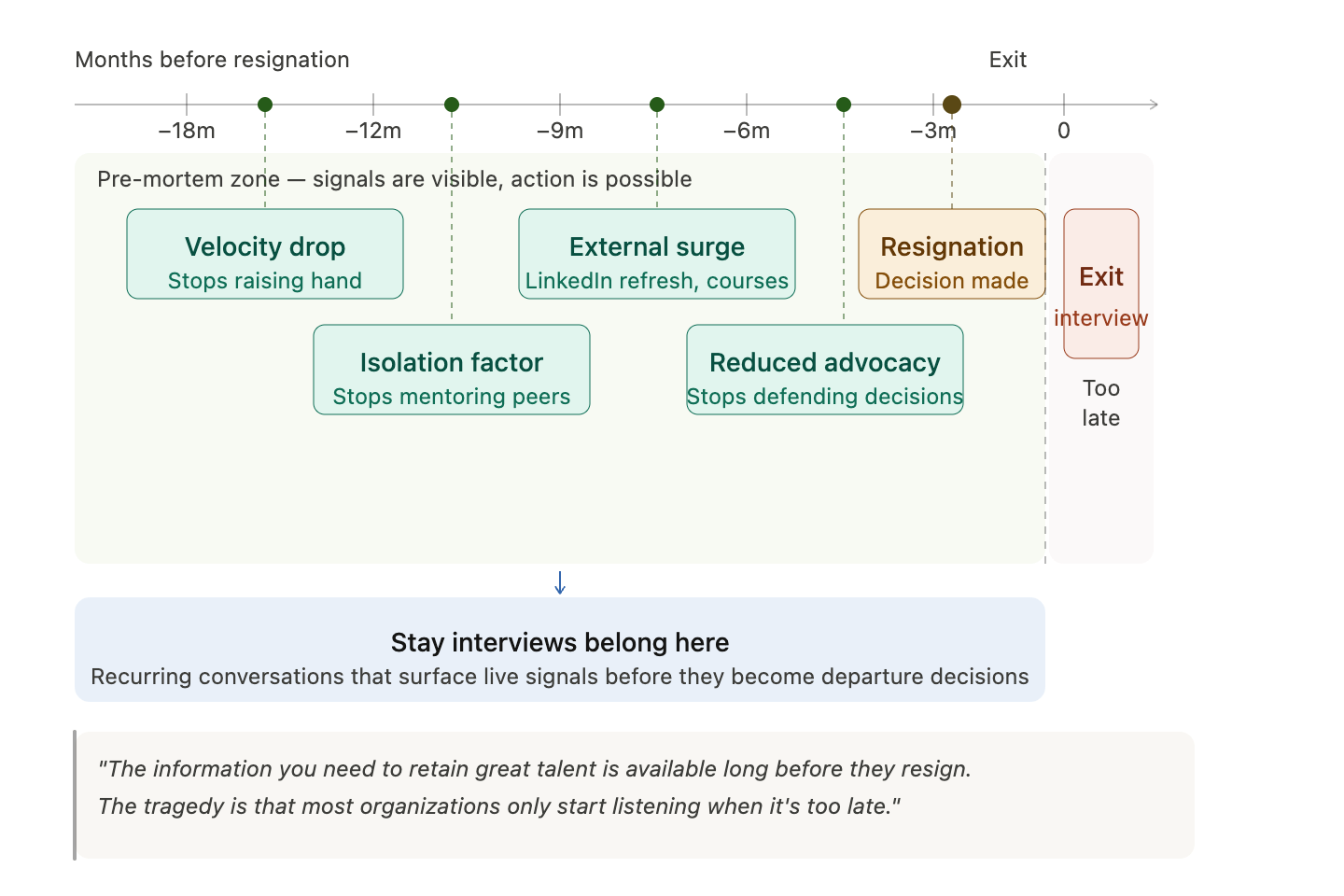
To build a high-performance culture, you must move from reactive post-mortems to pre-mortems that anticipate regrettable loss before it happens.
“The information you need to retain great talent is available long before they resign. The tragedy is that most organizations only start listening when it’s too late.”
Anticipating Loss: The Pre-Mortem Framework
Retention is a predictive discipline, not a reactive one. Top talent rarely leaves for a single reason — they leave because of a slow accumulation of friction. The signals of disengagement are readable if you’re looking for them. The problem is that most managers are not trained to read them, and most organizations don’t create the rhythms that make reading them possible.
The silent signals your best people are sending:
The Velocity Drop. A high performer who suddenly stops pushing for new projects, or becomes unusually “agreeable” in meetings, has likely checked out. The person who used to raise their hand unprompted has gone quiet. They still do their job — they’ve stopped trying to improve it.
The Isolation Factor. Are they no longer mentoring others? Top talent thrives on impact; when they stop investing in the team’s growth, they are preparing their own exit. They skip the team lunch. They’ve drawn a line between “what I owe this company” and “the rest of my life.”
The External Surge. They’ve started taking courses in skills your organization doesn’t need, or suddenly refreshed their LinkedIn, or mentioned a conference in a city where your competitors are based. Use LinkedIn insights and industry networking to see if your niche is being targeted — if your competitors just raised a massive round, your best people are currently being headhunted.
Reduced advocacy. They’ve stopped defending organizational decisions to peers, stopped referring their network to open roles, stopped talking about what the team is building. They’ve emotionally decoupled from the mission.
The High-Performer Ratio: The 20/70/10 Rule
You cannot treat every employee equally because their impact isn’t equal. High-performers are force multipliers — one exceptional individual can raise the output, ambition, and standard of an entire team. But they are not infinitely scalable, and getting the ratio wrong is as dangerous as getting it right is powerful.
The right distribution:
20% Top Performers: Drive 80% of innovation and value. Require the most autonomy and the least “management.”
70% Core Contributors: The reliable engine room. Need clear paths and stability.
10% Underperformers: In active coaching or transitioning out.
Warning signs of imbalance:
One person’s absence would stop key projects cold
Top performers shielding underperformers from consequences
High performers never given time for deep work
“If X left, we’d be in serious trouble” — heard regularly
All complex escalations go to the same 1–2 people
The Danger Zone: If your top performer ratio climbs above 30%, you often see cultural combustion — too many high-stakes operators fighting for the same projects, leading to burnout and internal friction. Drop below 15%, and your team is running on institutional inertia, burning out the people who still care.
Managing the high-performer ratio requires a structured approach. I’ve consolidated all key questions into a single template. 👉🏼 If you want a copy of the sheet to use with your own team, just drop a comment and I’ll send it over.
A Word About Top Performers
The cruelest organizational irony: the people you can least afford to lose are the ones you most readily overload. Top performers get rewarded with more work. Their capability becomes a liability. And because they’re high in conscientiousness and low in boundary-setting — it’s partly why they’re top performers — they absorb the load past the point of sustainability before anyone notices.
“When you give your best person every hard problem, you’re not honoring their talent. You’re scheduling their departure.”
High performers will rarely tell you they are overwhelmed — they see “doing it all” as part of their identity. Watch for these mechanical failures instead:
Quality Erosion. When a perfectionist starts making uncharacteristic tactical errors, that’s not a skills problem — it’s a capacity problem. Overloaded top performers don’t crash; they compress. “Good enough” replaces excellent.
The Always-On Lag. If they’re sending emails at 2 AM and 7 AM, they aren’t being productive — they’re compensating for a lack of bandwidth. If vacation isn’t restorative, the underlying load hasn’t changed.
Owning more than two critical dependencies. If your top performer is blocking three or more separate workstreams because others are waiting on their input — they are structurally overextended, regardless of how gracefully they’re coping.
The Rule of Two: No top performer should own more than two “if this person disappeared tomorrow, we’d be in serious trouble” responsibilities simultaneously. If they do, you’re not leveraging talent — you’re hoarding it.
The Anti-Exit Questionnaire: 10 Questions That Actually Matter
To save your team, flip the script. Stop treating feedback as something you collect on the way out. The questions below are split into two sets: five to ask now — in recurring stay conversations — and five to ask if, despite everything, someone is already heading for the door.
Before They Resign — The “Stay Interview”
“What is the one thing that could happen this month that would make you start looking for a new job?” Direct, specific, and time-bounded. It surfaces the live trigger, not a vague grievance.
“If you were recruited by a competitor tomorrow, what’s the one thing they could offer that we currently don’t?” The competitive framing bypasses defensiveness and gets to the real gap — in growth, comp, culture, or autonomy.
“Which part of your job feels like a tax on your productivity rather than an investment in your growth?” Opens the door to process friction, bureaucratic drag, and the organizational stupidity that erodes engagement slowly.
“Do you feel your current projects are building the internal resume you want for your next promotion?” Growth ambiguity is a top driver of departure. If they can’t see the path forward here, they’re mapping alternatives.
“On a scale of 1–10, how much of your workday is spent in flow state versus firefighting?” Learning velocity and deep-work access are retention drivers most organizations underestimate. When the ratio inverts, departure accelerates.
To be effective, these questions should be baked into your regular 1:1 or used during regular touch points. Here are my thoughts on “running effective 1:1s". The goal is to catch the "silent signal" before it becomes a loud resignation.
At the Exit — The Brutal Truth
“At what specific moment did you decide to look?” Traces the exact inflection point. The origin story of the resignation is the most actionable data you’ll collect all day.
“What did your new company do during the hiring process that made you feel more valued than you do here?” Uncomfortable but essential. Tells you exactly what your culture, process, or leadership failed to communicate.
“If you were CEO for a day, what is the first legacy process you would abolish to save this team?” Reframes the conversation. People in transition say things they’d never say during their tenure — create the space for it.
“Was there a specific system or tool that failed you — or made your job harder than it needed to be?” Surfaces operational dysfunction that the organization may have normalized but new eyes would find alarming.
“Who on the team is likely to follow you out if things don’t change?” A departing employee knows the team better than any survey. Many will tell you — because they want good things for their peers even as they go.
Don't worry about copying these down—I’ve already mapped all 20+ questions into a plug-and-play Google Sheet. 👉🏼 If you want a copy of the sheet to use with your own team, just drop a comment on this post and I’ll send the link directly.
If you’ve read my user-guide, you know that my motto is “be brief, be bright”…in this case, my mantra is: be brief, be bright, be proactive!
The best retention strategy is not a better exit interview — it’s an organization where people feel seen, growing, and necessary long before anyone asks them why they left.
So, take the “stay interview” seriously and start asking questions today!
Wait, Wait, There is More!
If these questions sparked some ideas, I’ve built a comprehensive Anti-Exit Master Template that includes 20+ questions, organized by strategic intent and target audience (I’ve also added my favorite question of all times…).
It’s designed to be used as a live scorecard for your 1:1 rotations and post-mortem reviews.
Agree; do not understand the purpose of an exit interview.
Overloading high performers is often why the team including the leader is or will be stagnant.
Nothing to lose except the high performer 🤔.