
Knowledge Is Not Power. Action Is. ⚡️
Why the era of "Systems of Intelligence" is ending and the age of the "System of Actions" has arrived.

For the last decade, we’ve been obsessed with Systems of Intelligence—dashboards, analytics, and big data that told us what was happening. But intelligence alone doesn’t move the needle. Actions do.
The worst thing you can do with information is to let it remain mere 'knowledge'.
This has been true for humans, of course. It’s about to accelerate in the agentic era, with the advent of what I’ve been calling “Systems of Actions”.
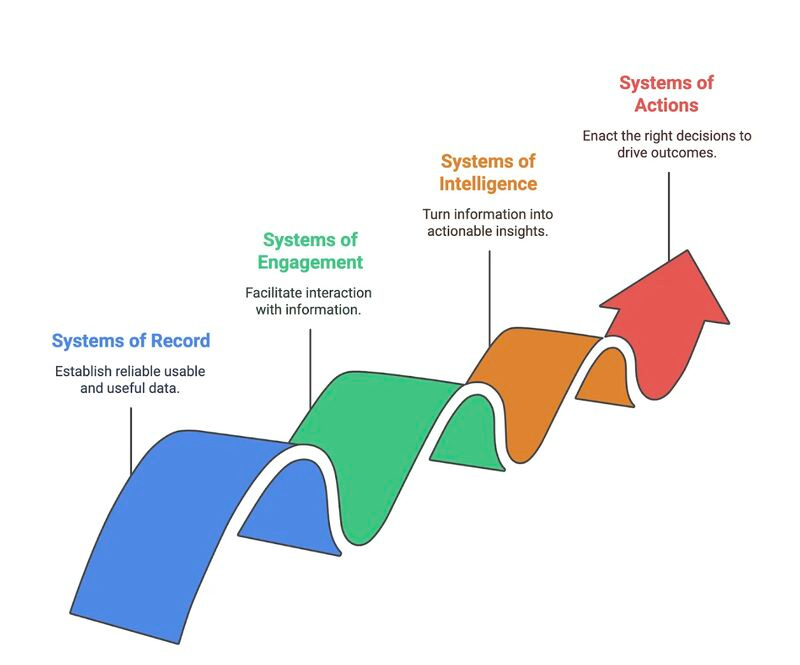
I hope you’ll enjoy the quick knowledge byte I’ve recorded for you here.
If you want to dive deeper into the topic, check out the longer form blog here. If you’re a subscriber to this blog (it’s free), you can also join the conversation here.
A Deeper Explanation of “Systems of Actions”
I had the opportunity to talk with Tony Baer and Matt Housley about this topic on their “It’s All About Data” podcast (it just crossed 50k views so I guess it’s quite popular).
Some of the questions being debated here
Q: Will the System of Actions require a modernization of the “Modern Data Stack”? A: Most likely. The “Modern Data Stack” was optimized for data-warehousing and structured data. “Systems of Actions” rely on the convergence of structured and unstructured data, run on real-time data, and require optimization from models to the application layer.
Q: Can “Systems of Actions” be run on one cloud or one application framework? A: They can, but it wouldn’t be optimal because the average organization is hybrid. Most companies run on multiple clouds (and on-prem data) and their user journeys traverse multiple applications. The best “Systems of Actions” are hybrid by design.
Q: What makes or breaks a System of Actions?
A: Success depends on three critical dimensions. I call this the “Triple A” Framework:
Autonomy: Defining the boundaries and risk profiles that allow the system to make real-time, responsible decisions without constant human intervention.
Agency: Ensuring the system has purpose-driven objectives—whether focused on revenue, safety, or customer satisfaction—so it isn’t executing blindly.
Accountability: Moving away from “black box” AI. You must have transparency, audit trails, and data lineage to understand exactly how every decision was reached.
The foundation of these systems isn’t just code; it’s trust.
The bottom line?
We are moving past the era where having the best dashboard wins the game. In the agentic era, the competitive advantage shifts to those who can bridge the gap between knowing and doing.
As you evaluate your own roadmap, ask yourself: Is your data just sitting there becoming “knowledge,” or is it actually doing the work? The future belongs to the Systems of Actions.
Action matters. Thanks Bruno
Spot on, Bruno. We’ve spent the era of the 'Modern Data Stack' building 'Systems of Intelligence' that are actually just 'Systems of Interruption.'
The reason 70% of BI sits unused isn't a lack of data; it's the friction of the 'Data Pivot.' Most users have to:
1. Leave their primary workflow
2. Log into a separate BI tool
3. Navigate to a dashboard
4. Interpret the charts
5. Return to their main app
6. Remember the insight
7. Figure out how to actually act on it
By step 4, most people have already given up. We have to move toward Systems of Action where the insight is embedded exactly where the decision happens. I recently broke down this 'Dashboard Utilization Crisis' and how to fix it here:
https://www.linkedin.com/pulse/dashboard-utilization-crisis-why-70-your-bi-investment-daliso-zuze-xvh6e/