
How Leaders Fail
It's not just execution. It's diagnosis. Introducing the Cynefin Framework.

I used to think leadership was about having the right answer. I was wrong.
At a recent leadership intensive, we dismantled the biggest myth in the C-suite: that all problems are created equal. They aren’t.
Treat a Complex problem like a Clear one and you don’t just fail — you walk off a cliff.
Not all problems Are Created Equal
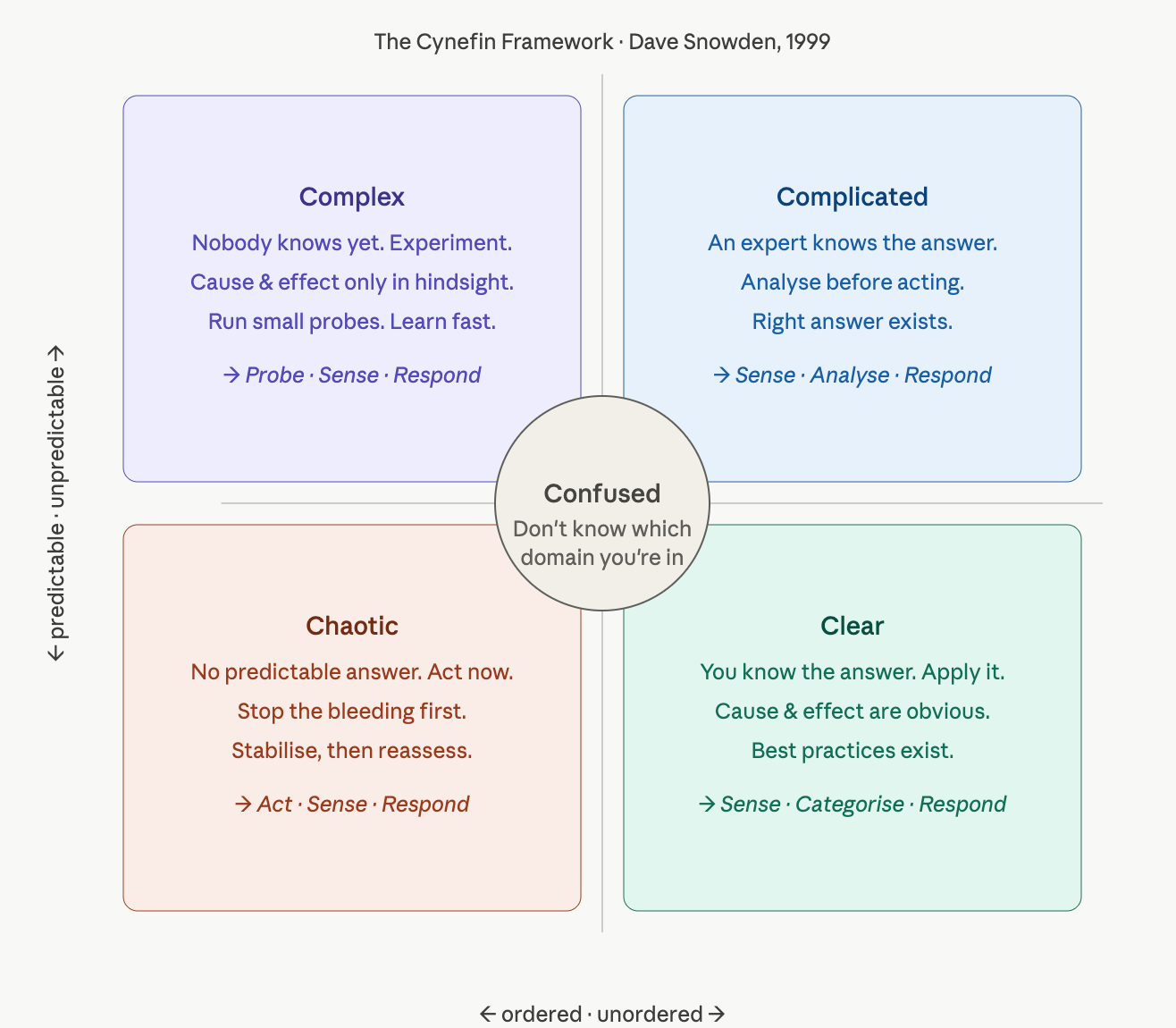
The antidote is the Cynefin Framework, developed by Dave Snowden at IBM in 1999. It doesn’t tell you where your data fits. It tells you what kind of world you’re operating in before you act. That’s a different question entirely — and a more important one.
In fast-moving environments, we’re tempted to categorize early and move fast. That instinct is expensive. When you box in a situation before the patterns have emerged, you miss the subtle signals that precede total system failure.
The Five Domains
Clear — Cause and effect are obvious to everyone. Best practices exist. Your job is to recognize the category and run the playbook. Sense → Categorize → Respond.
Complicated — There’s a right answer, but finding it requires expertise. Slow down, bring the right people in, and analyze before you act. Sense → Analyze → Respond.
Complex — No clear causality. The system is evolving in real time. Analysis won’t help you here — safe-to-fail experiments will. Run small probes. Learn fast. Probe → Sense → Respond.
Chaotic — High-velocity crisis. The relationship between cause and effect has broken down. Stop the bleeding first; ask questions later. Act → Sense → Respond.
Confused — The most dangerous place of all. You don’t yet know which domain you’re in, so you default to habit and personal bias. This is where most leadership failures happen. Stop moving until you’ve diagnosed the environment.
The Cliff Warning
The boundary between Clear and Chaotic isn’t a gentle slope — it’s a drop. When leaders mistake past success for future immunity and stop questioning their assumptions, they’re already at the edge.
The cliff doesn’t announce itself.
Recovery, when it comes, is slow and expensive.
The “Now What?” Checklist
Before your next meeting, run this:
Identify the domain. Is this a problem for an expert (Complicated) or an experiment (Complex)? Name it before you try to solve it.
Avoid the Clear trap. Are you oversimplifying? Applying best practice to a Chaotic situation doesn’t slow the crash — it accelerates it.
Probe before you plan. In Complex environments, skip the roadmap. Run the smallest test that could teach you something.
Check your bias. Feeling stuck or confused? You’re probably in the Confused zone. Don’t act on instinct. Diagnose first.